Life and Death
Lately, I’ve been spending a lot of time studying Greek myths. If it were me reading these myths seven to eight years ago, I’m sure I wouldn’t understand much about them, except for the clear and blatant moral question. However, now, having passed through many thresholds and armed with a better understanding of the mind-soul phenomena or the intrinsic ways it plays into how we perceive ourselves and life, we are in a position to become a living archetype of transformation. To say I am fascinated by Greek myths is obviously an understatement. My soul puts a big ass grin on my face while I discover all the beautiful and complex stories of the Greeks. Like a child in a candy shop, a silent warmth moves through my soul. Life and death have always been the riddle that was born to be solved but never quite answered since the beginning of time. It’s a constant… like change. One thing we are sure of is change. Seasons change, stories change, people change, and the world along with it. And that’s okay, I guess.
In this post, I will try not to get too philosophical because I happen to have a bad headache again. In my last post, I was also battling a terrible headache and seasonal allergies. Perfect timing, of course. Now, having covered a little bit of what I want to do, I want to focus on the mystery we call life and the other side of the coin, death. While yes, when we think of death, we are mainly referring to the physical process of dying, I want to invite you into the world of the Greeks, poets, mystics, and philosophers, and what death implies beyond the physical manifestation of it. According to the Hindus, every breath we take is an act of dying. When we inhale and exhale, life and death participate in the cosmic drama. When a thought arises and subsides, when love rises and leaves, when the sun rises and sets, when the moon rises and sets, and when a wave forms and breaks, it is also life and death that participate in the cosmic drama.
Still, today we haven’t found an answer we can all agree on about what the purpose of life and death is, and we can’t deny that the question often arises: What’s the point in being born when we all have to die? From a more spiritual and religious sense, although they do differ, the underlying moral message is the same. We are here to get to know God. We are here to serve God and understand God, His power through His magnificent creation. Sometimes, we spiritualists forget this and still get caught in the mundane world, but in the end, we always come to the same experience, maybe from a different path, that yes, we are here to witness God’s creation, give glory to His creation, and hopefully understand what God wants, including our place and purpose in this cosmic drama.
Knowledge, the forbidden fruit
Something that really captured my attention recently, when I read about Hades and Persephone, was the similarity of the story with the biblical drama of Adam and Eve, the temptress. I understand most of the myths intuitively now, and it is kind of mind-blowing when you understand the archetypal narrative to interpret something so human and inward. As I mentioned previously, I probably wouldn’t understand much if it were me reading these myths several years ago, and probably still don’t for the most part, largely due to the genius of how they were written, where the reader is invited to constantly solve a riddle that can to a great extent be understood through lived experience, and where we are constantly contemplating and unraveling the true meaning behind it.
Persephone, the gentle young girl who liked to pick flowers beneath the Sicilian sun, became the queen of the underworld. But who is she really, and how did she become the queen of the underworld? Before I get into that, let me start by saying that the couple, Hades and Persephone, was actually a happy one, contrary to all expectations, of course. Persephone took her role as queen very seriously, as did her role as wife. Her presence brings a new image and understanding of life and death to Western civilization, since the young woman shares her time between the two worlds, the lower one and the upper one. This marriage, though eventually accepted, did not improve the reputation of the lord of the underworld.
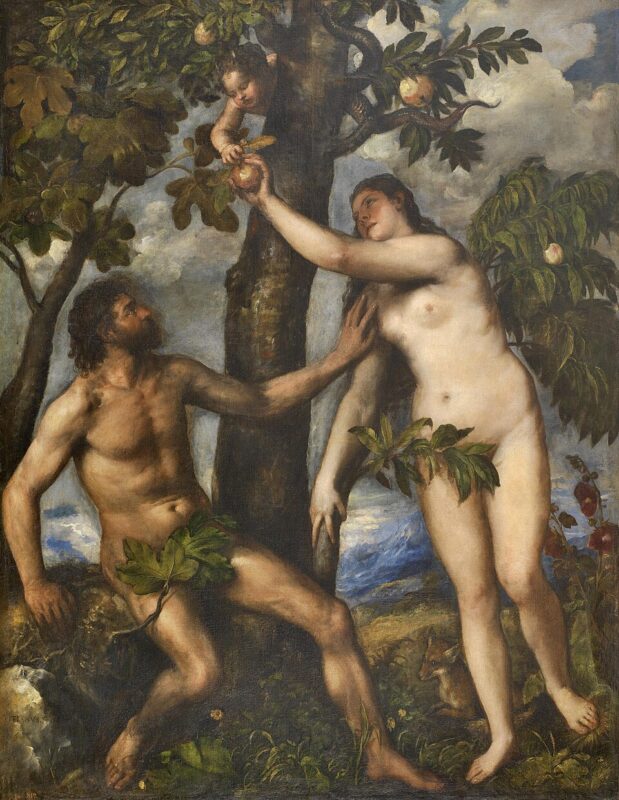
Though many stories differ, I can’t help but notice the same underlying message recurring throughout different cultures and eras. In mysticism, the whole idea of dying is a means to know something. Without death, there’s no knowledge. When we look at the story of Adam and Eve, Eve was deceived by the serpent, ate from the Tree of the Knowledge of Good and Evil, and gave some to her husband. When we look at Persephone, though a different narrative, she too ate the pomegranate seeds of the underworld, and though she tried to deny it, Ascalaphus witnessed it and reported it to Demeter, and therefore she was not granted total freedom to return and live on the surface, but had to abide by the law and live between the two worlds. In both stories, the act of eating is not just physical; it is the moment knowledge is gained, and with it, consequence.
Knowledge is not something that is simply given. It is something that is taken, and often through a crossing of a boundary that cannot be undone. It is like an initiation. As we all know and have experienced throughout the course of living, once we see, we cannot unsee. In that sense, knowledge is not only the end of innocence as often depicted or interpreted in the Bible, but also the beginning of awareness, self-awareness. Adam and Eve are cast out of the garden, no longer able to exist in unconscious harmony, as living in unconscious harmony is one of the main paths provided by the universe. And Persephone, having eaten in the underworld, is now bound to live between two worlds. This is not punishment in the way we often simplify things, but a consequence. To know means to carry, and as I often mention in my posts, to carry is to live with the tension of opposites, between light and dark, the outer and the inner, or life and death.
Hades falls in love at first sight | Hades and Persephone
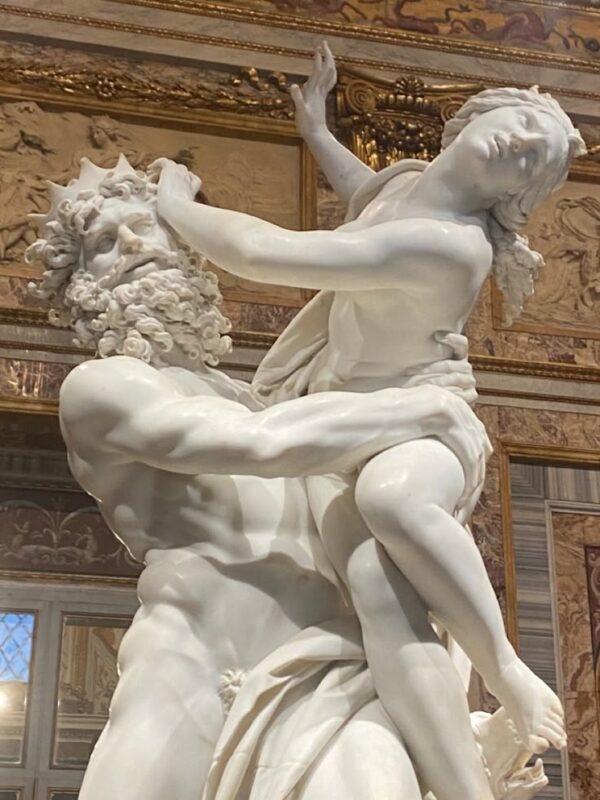
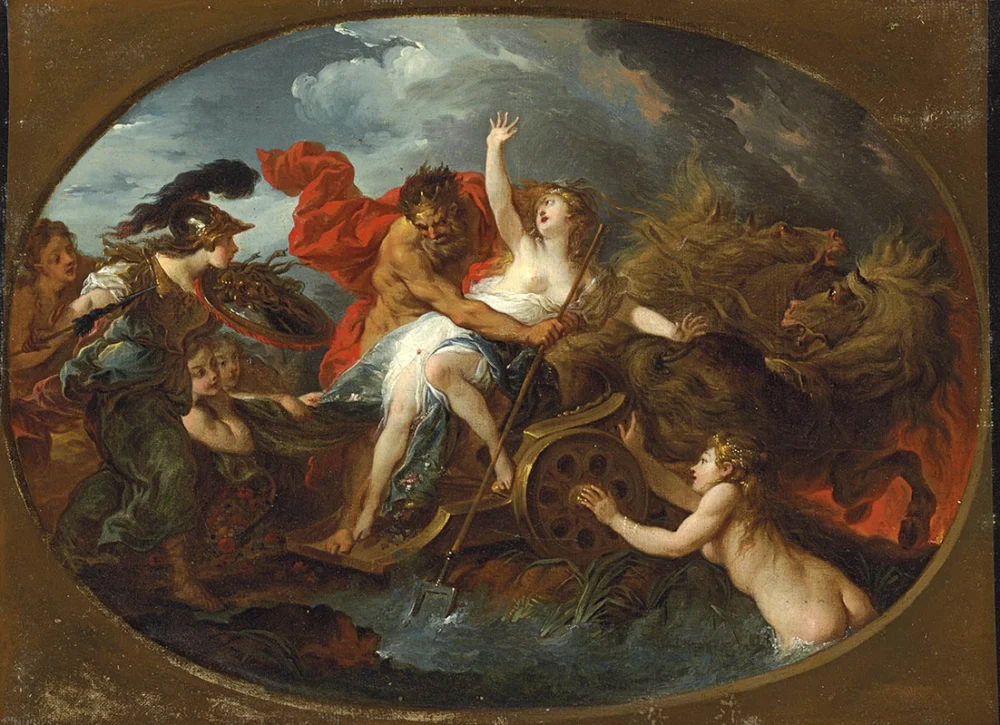
Hades is a rich god surrounded by precious stones and rare metals, gold, diamonds, rubies, and possesses nothing on the earth’s surface. No mortals dedicate temples or altars to him, and if they do praise him with sinister ceremonies and sacrifice, they do so in secret. He lives below in the darkness and has no idea of what goes on in the upper world or on Mount Olympus. The only news he receives of the world is contained in the oaths and curses that mortals utter as they strike the ground with their hands. Sometimes he feels the need to leave his infernal palace and breathe the outside air. One day, having left the depths of his kingdom, Hades drives his chariot pulled by horses across a Sicilian plain, not far from Mount Etna. He’s indifferent to the beautiful landscapes, forests, and valleys of Greece, but suddenly a silhouette draws his attention. He suddenly brought his horses to a halt, and there, just a few steps away, a young girl of exceptional beauty was picking flowers. Her name is Persephone , which signifies bringer of destruction. And this young girl is not just anybody. She is the daughter of Zeus and Demeter, the goddess of agriculture and harvests.
On Mount Olympus, where she is sometimes allowed to go, she is known as Kore, which simply means the young girl, the maiden. Hades’ heart goes wild. He could kidnap her, but being her brother’s daughter, he respects the law. Hades sets off to see his brother Zeus and ask for Persephone’s hand. This is hugely embarrassing for Zeus because if he refuses, he offends his brother, and if he accepts, Demeter, will never forgive him. Zeus is conflicted, so he ducks the question and says I can neither give or refuse my consent. Hades considers himself free of all constraints and heads back to Sicily and the plain of Etna. Persephone is still there in the company of nymphs. Hades puts on his cap of invisibility and disappears. A few moments later, as Persephone bends to pick a flower, the ground abruptly opens beneath her feet, and Hades carries her off into the pit of the dead and the night.
Demeter | Goddess of Harvest
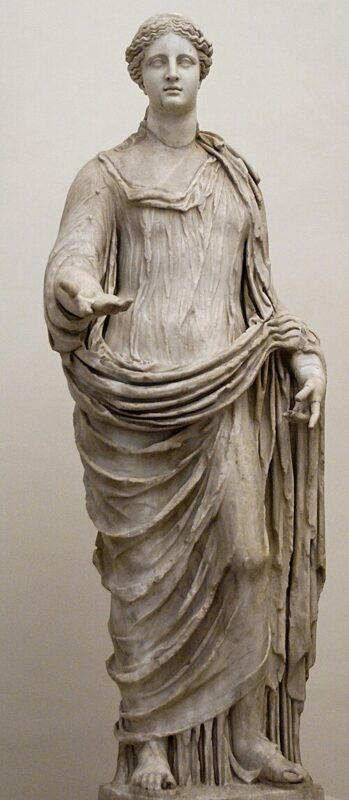
When her daughter doesn’t return, goddess Demeter goes to look for her and questions everyone she meets, but no one tells her the truth, nor the man, nor the gods, nor the birds, nor the nymphs, no one. Until an old woman approaches her, Hecate. Hecate is the goddess with double powers.She is the goddess of fertility and the goddess of the moon. When the moon is full, lighting the night sky and making men and beasts mad, it is said that Hecate points out the path to the underworld. This goddess stands at the crossroads between good and evil, between ferility and drought. Hecate is the only divinity who, of her own free will, goes down to see Hades at home. Hecate had heard Persephone call for help the other morning, but when she got there, no one was to be found. Demeter, without pausing for breath, for nine days and nine nights, continues her search through mountains, forests, lakes, and valleys, all in vain. When all hope seems to be lost, Hecate takes her to see Helios, the god of the sun, who sees everything. Helios decides to name the guilty party. Hades.
Demeter demands the return of her daughter, but Hades refuses. “In that case,” announces Demeter to the assembly of gods, “I leave Olympus never to return, and the earth will be sterile until my daughter is returned to me.” This is no empty threat. She is the goddess of wheat and nourishment. The following day, the crops start to fail, fruits rot, and famine ravages the earth. The human race is threatened with extinction. In his palace, Zeus is at a loss to know what to do. He sends Demeter his messenger, the Goddess Iris, to beg her to see reason. Demeter doesn’t want to hear it. A delegation of gods and goddesses goes to plead with her without success. Zeus, with no choice left to him, sends his son Hermes to see his brother Hades with the following message. “If you do not give back Persephone, we are all lost! Mankind will die, and there will be no one left to honor us, no one left to believe in us!”
Hades considers and accepts. He is willing to give Persephone back to her mother, but on one condition. The laws of the gods must be respected, as he respected Zeus when asking for Persephone’s hand. And there is a law in the underworld which everyone is aware of and which no one may violate: whosever has consumed the food of the dead will remain beneath the earth for eternity. Hermes questions Persephone if she tasted any food, but she assures him that she has been so unhappy since being kidnapped that she has eaten nothing. Hades, therefore, accepts that she return to her mother’s side. Just as Hermes is helping the young girl onto his chariot, a voice rings out. It is Ascalaphus, one of the gardeners of the Lord of Darkness. “She’s lying,” he declares, specifying that he saw Persephone picking a pomegranate and ate seven grains from it, and is willing to bear witness to it. Ascalaphus is to regret these words later, when Demeter turns him into an owl.
Saddened than ever, Demeter shuts herself away all alone and refuses to return to Olympus and continues to starve mankind. Zeus explains the problem to Rhea, his mother, for Rhea is also the mother of Hades and of Demeter. It is Rhea who will preside over the negotiations between her three children, Zeus, Demeter, and Hades. There is discussion, debate, and tears, and at last, agreement has come. Persephone, because she has tasted the food of the dead, will spend her winters in the underworld, and the rest of the year she will be in the fresh air with Demeter. And that is why when Demeter and Persephone are separated, the earth freezes, nothing grows or flowers, and refuses to feed mankind. Nature is waiting for Persephone to return.
Hades, the master of the underworld | Self-awareness
So, who is Hades really? To reduce him to just the god of death would be fatal because he isn’t exactly death. Death is another god, Thanatos. Hades, son of Rhea and Cronus, and brother to Zeus, contrary to many beliefs, is neither satanic nor evil-doing. It is not he who torments his subjects. That is the Erinyes, the goddesses of vengeance who are a law unto themselves. Crowned with snakes, armed with whips, it is the Erinyes who relentlessly persecute their victims, going so far as to make them mad. Hades has nothing to do with that. He governs the underground world.
Hades, the god who isn’t named, reigns over the underworld kingdom, which he never wanted but was allotted to him against his will. When Zeus overthrew his father, Cronus, to liberate all his siblings and took power, he decided to share the universe with his brothers. Zeus took the world of men and the celestial world for himself, gave Poseidon the sea world, and gave Hades the underworld. The fear that Hades awakens is so great that rather than speak his name, he is referred to by all sorts of nicknames: the Receiver of Many, the Illustrious, the Giver of Good Counsel, or even the Zeus of the underworld. With a scepter in his hand, he governs the souls of the dead.
He is surrounded by monstrous creatures with precise functions. Out of duty, he pretends to be pitiless, but in his heart, he is also wise and sometimes tender. If approached in the right way, he is capable of showing a certain indulgence. For instance, Orpheus, a warrior and the most famous poet and musician of all time, pays Hades a visit before death comes to reap him. With no weapon or violence, but only his lyre and voice, Orpheus manages to fight his way through to the infernal couple. Orpheus, after a life of adventures and exploits, met Eurydice, a nymph of incomparable grace.
Overcome by an immeasurable passion, he married her, but their happiness did not last long. Eurydice dies, and Orpheus, mad with grief, dares to do what no other mortal had dared to do before him. He descends into the underworld and asks the infernal couple for the return of his love. Both speechless, poised to punish such impudence, Orpheus stops them with an imploring gesture, striking a sensitive chord, he reminds Hades of the feelings he experienced towards Persephone, the flight of love that he succumbed to, his desperations and sadness when the one he made the queen of the underworld is kept far from his side.
Softened by the celestial notes and the poetical musician’s words, Hades and Persephone give in to his prayers, on condition, of course, that the laws of the underworld be respected. Orpheus can leave, Eurydice will follow him, and he must never turn around, not before reaching the surface. If he disobeys, then Eurydice will be lost to him forever. The destiny of Eurydice now lies in his hands alone.
This decision sheds light on the multiple facets of the personality of the master of the underworld. He is music-loving, sensitive to lovers’ laments, and capable of being moved by beauty. However, whatever he does, in the eyes of mortals, Hades will always be this feared and detested god. When in truth he is both life and death. On certain evenings, overcome by sadness, Hades says to himself that mortals are very wrong to fear him, because real death, as the Greeks well knew, is not the underworld but being forgotten.