Brace yourself. It is going to be a long one. Almost all esoteric doctrines, including yoga and Hinduism, discuss the four elements as the foundation of the physical phenomena in the Universe that we know and can observe. Circa 2013, on the first day of my yoga training here in New York City, one of the lead teachers began explaining how yogis understand the world through Hindu cosmogeny. She asked, “So what was in the beginning?” And while everyone knew about the Big Bang, she followed with, “And what came after the Big Bang? How did we end up with life here in our solar system?” The room went quiet.
It was a simple question, and maybe a scientist might have had a direct explanation, but it would obviously lead to more questions. Then she said, “The four elements came: Fire, Water, Air, Earth.”
While I thought I was more than prepared for such a discussion, having studied various doctrines at least five years prior, I was still taken aback by the simplicity and the insight, more of a bird’s-eye view, so to speak. There are countless cosmogonies written about the birth of the Universe. Just the thought of how much there is to read and study overwhelms me every day. But one thing I am getting better at is taking it one day at a time.
Twenty-first century teachers describe the four elements as the biggest beings in the Universe. While we probably think of the elements as resources we can exploit or dominate, in the spiritual or metaphysical realm, there is much more going on with them.
Water H₂O
We all know water as H₂O, a simple molecule made of two hydrogen atoms bonded to one oxygen atom, the substance that makes life possible on Earth. When I was in middle school, we were still debating or speculating whether there was water anywhere beyond planet Earth, and it was a big deal. But I mean, a big deal. Now that we have confirmed water on other planets and moons, the idea has become almost ordinary, but in my generation, this was something we could only dream of. Confirmation of water outside our planet came after 2005 with Cassini and even more in the 2010s. Even comets are mostly water ice, as well as many asteroids with hydrating minerals. We have also detected oxygen on Mars, Venus, and several moons in our Solar System, but not in the same quantities as Earth.
Now, beyond its scientific identity, water has often been seen as something that holds memory, emotion, depth, mystery, and the ability to cleanse and transform. Many cultures have viewed it as alive in its own way. So even though we can study it in a lab, there is another side or dimension to water that invites us to look past its chemical makeup and into the deeper form it carries.
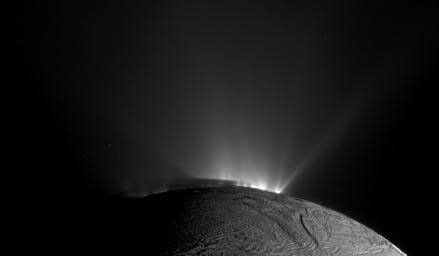
Water for us moves downward, not upward, unless you are on Saturn’s moon Enceladus, where water from an underground ocean is forced upward through cracks in the ice, erupting into space in visible jets like giant sprays. Water has also been used as a symbol of purification and holiness, especially in Christianity, and with the new ritual of baptism that came with the Essenes or whoever the first Christians were.
While water seeks life and depth, fire seeks height and sublimation. Sublimation in science is the process by which a solid changes directly into a gas without passing through the liquid state. It is extremely important in the search for life on other planets because it helps scientists understand how, i.e., water ice or other volatile substances, can move, disappear, or reappear on a planet’s surface, which affects where life might exist.
In spirituality, sublimation is the process of transforming raw or lower energies of desire or impulsiveness into higher states of awareness, creativity, or spiritual growth. Just as a comparison of how our ancestors understood the elements. Fire was represented by the Stars in the sky, like our own Sun, our destiny, and water was a representation of our inner mystery, associated with emotion, memory, imagination, and feeling.
Here’s a Hindu text for reference, which I thought was worth noting, as stated in the epic Itihāsa, the Mahabharata.
“I am Narayana, the Source of all things, the Eternal, the Unchangeable. I am the Creator of all things, and the Destroyer also of all. I am Vishnu, I am Brahma and I am Shankara, the chief of the gods. I am king Vaisravana, and I am Yama, the lord of the deceased spirits. I am Siva, I am Soma, and I am Kasyapa the lord of the created things. And, O best of regenerate ones, I am he called Dhatri, and he also that is called Vidhatri, and I am Sacrifice embodied. Fire is my mouth, the earth my feet, and the Sun and the Moon are my eyes; the Heaven is the crown of my head, the firmament and the cardinal points are my ears; the waters are born of my sweat. Space with the cardinal points are my body, and the Air is my mind…
…And, O Brahmana, whatever is obtained by men by the practice of truth, charity, ascetic austerities, and peace and harmlessness towards all creatures, and such other handsome deeds, is obtained because of my arrangements. Governed by my ordinance, men wander within my body, their senses overwhelmed by me. They move not according to their will but as they are moved by me.”
— Mahabharata (translated by Kisari Mohan Ganguli, 1883-1896), Book 3, Varna Parva, Chapter CLXXXVIII (188)
Water, baptism, and holiness
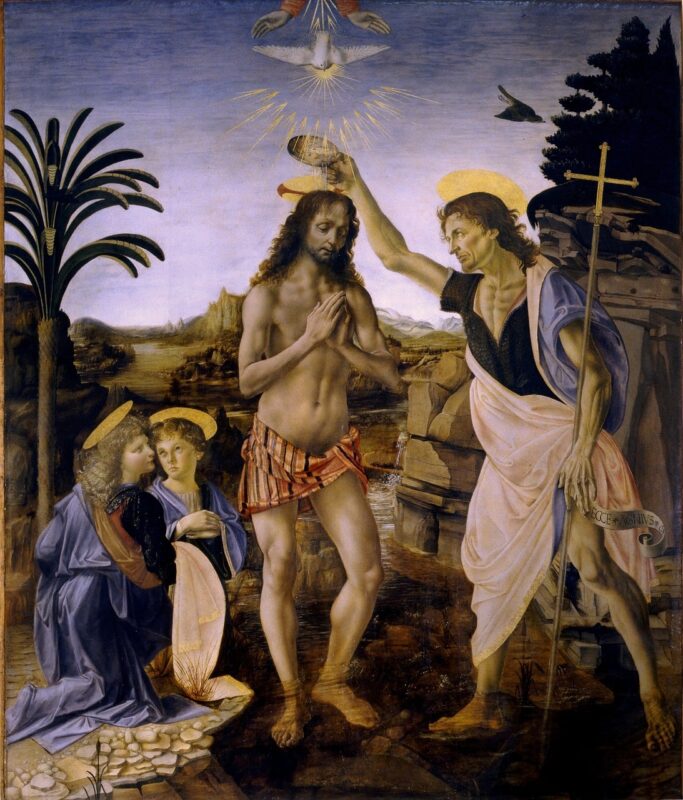
Baptism and the symbol of purification mark the culmination of the Age of Pisces, the era that begins with the coming of Jesus Christ and carries the themes of water, faith, sacrifice, and spiritual rebirth. All things that are represented by the sign of Pisces that astrologers know very well, better than I can ever say. The painting is by Leonardo da Vinci. Notice how Jesus’s feet are immersed in water as well as John’s, performing the holy ritual of purification on Jesus Christ. It actually reminds me of Temperance in the Major Arcana of the Tarot, representing healing, patience, and the reconciliation of opposites within, all things essential for one’s spiritual actualization.
While the 60s are said to mark the beginning of the Age of Aquarius, throughout this period, the Age of Pisces, water became more than a physical element. It turned into a holy tool, something capable of cleansing not just the physical body but the unseen realms around us. In Christianity and in many older traditions, water is blessed, prayed over, and infused with intention so it can cast out demons, break negative attachments, and support acts of exorcism and spiritual protection. Holy water in these rituals is used not just as a weapon but as a reminder of purity, surrender, and the return to one’s original state before fear and darkness take over. So water then becomes a bridge between the physical and the spiritual, emphasizing the same idea found in baptism, the teachings of Jesus Christ, and the esoteric understanding of water as the element of memory, dissolution, renewal, and transformation.
Water has the power to transform our identity on a cellular level, especially with the right intention in mind and spirit. Even a simple bath at home can become a powerful ritual of purification and healing. As long as we hold the truth in our hearts and remain honest before the holy, water will do its job and cleanse us of our sins, marking a rebirth in its own way.
John 3:5
“Jesus answered, Truly, truly, I say to you, unless one is born of water and the Spirit, he cannot enter the kingdom of God.”
Matthew 3:11
“I baptize you with water for repentance, but he who is coming after me is mightier than I, whose sandals I am not worthy to carry. He will baptize you with the Holy Spirit and fire.”
Nymphs – Greek Mythology
In Greek mythology, nymphs were seen as the silent presence within nature, especially inside water. They were the soft, watchful spirits of a spring, a river, or a sea, like the Nereids. They weren’t gods, just subtle beings that held the mood and intelligence of the water they lived in.
Above is one of my favorite paintings in the more realistic and classical style. I’ve looked at this painting for years, and every time I return to it, it remains one of my favorites, especially within the theme of mythical creatures and fantasy. I grew up swimming before I could walk (I mean that literally, lol), and I’ve always connected to water in a way that is hard to put into words. I mean this in the most humble way possible. I have no desire to dominate water or challenge it, like riding big waves, etc., but more to meet it in its most serene state.
Growing up in the southern tip of Albania, by the Ionian Sea in Vlorë County, where both my parents are from, Vuno, to be more precise, apart from stuffing my face with prickly pears, feta cheese, and grapes, living among the calm, turquoise waters of Jalë and the surrounding beaches helped us, as natives at least, build an understanding and relationship with this element that is hard to put into words. Everyone in my family and culture quietly understands and relates. Rich in salt, iodine, and sodium, these waters offered a level of cleansing and purification that felt almost indispensable for the temperament of my people, lol, especially on my father’s side, in Vlorë City.
Story time
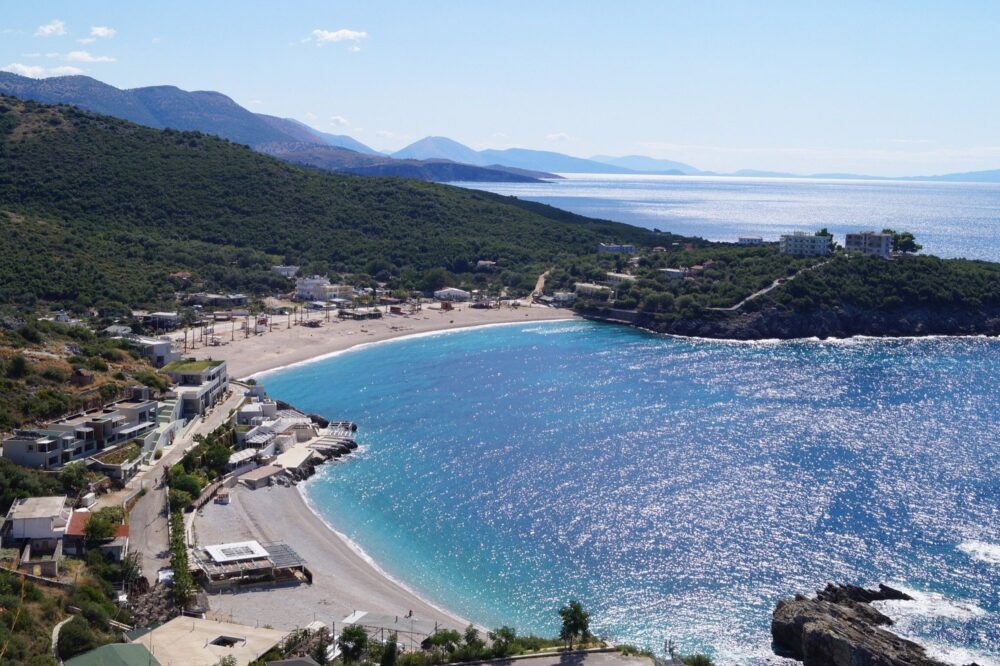
Now, a little story time and a fun fact about my ancestry, since some of you have asked. The picture above is a more recent one. When I was growing up, there was nothing there except the military base at the very far right of the picture up the hill. Sometimes my family felt adventurous enough to hike down from the village, which sits high in the mountains, through the olive terraces, and then down the steep slopes toward Jale, shown in this image. The whole walk took a good 60–70 minutes if I remember it right. There are also beautiful surrounding beaches not included in the image, where my brothers and cousins would swim to. We were that brave. Haha.
Vuno was a key base for resistance during WW2, also involving Greek Himariotes, where my grandmother was raised, only about a 30-minute drive from Vuno, with many villagers listed on monuments for their sacrifices. Among these heroes was my great-aunt, Amalí Andoni, my grandfather’s little sister, who was killed by Nazis and Italian fascists at the age of 16.
This is how the story was told to me for as long as I could understand words. One night, when the moon was full, Aunt Amali prepared food for the soldiers in the resistance, as she always did. She was brave but stubborn. On the way to the partisans, the German soldiers spotted her and shouted at her in German (my grandfather would shout in German when narrating the story), but she was determined to keep going and didn’t stop, and she was shot in the back several times.
The partisans later found the man who had done it and brought him to my great-grandmother and said, “It’s him. This is the Nazi who killed your daughter. What do you want us to do with him?” And my great-grandmother replied, “Let him go, for he too has a mother who waits for him at home.” These kinds of stories became part of my values and how I was shaped while growing up.
My grandfather would tell me this story almost every year, and he would always tear up halfway through. December 5th was his birthday, and so I thought, in honor of him, Piro Andoni, who raised me, I would tell the story. While my family is filled with stories I like to keep for myself, here’s one more fun fact about my grandfather. He was raised as poor as a… well, a very poor child. He told me that growing up, he would read books only with the light of the moon because he was so poor that he had no electricity. My upbringing wasn’t so different, by the way. He read so much, though, and even learned a whole new language, Spanish, that he later became the Albanian ambassador in South America for 13 years.
Growing up, I would hear him on the typewriter every day, writing stories from his diaries and about each country he had visited in South America. He spoke fluent Spanish, obviously, and he also raised me with some South American musical influence, which is kind of funny to me now, lol. He was based in Argentina and had a weird obsession with actress Greta Garbo, who had very similar features to my grandmother, with high cheekbones, small but defined lips, and clear blue eyes. He wrote an entire book about her life and translated it from Spanish. He would often talk to me about Greta Garbo and what her career as an actress meant for her, which I now, as an adult, see more clearly. He traveled through the entire South American continent with my grandmother, Athina Andoni, for all those years.
Okay! Enough of me, because I’m already cringing. See you in the next one.