The History of Tarot | Temperance
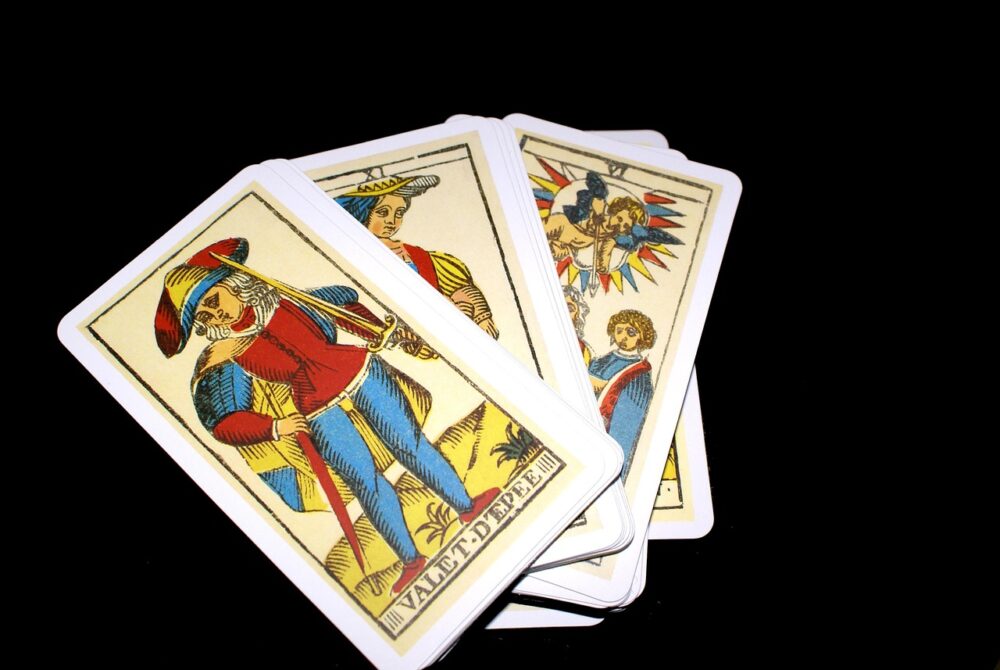
The Tarot is a card deck containing 78 cards according to a given system, with 22 cards of the Major Arcana and 56 cards of the Minor Arcana. Arcana (singular arcanum) means secrets or mysteries. The Minor Arcana is subdivided into four suits: Wands or Staves (fire), Cups (water), Swords (air), and Pentacles or Coins (earth). This post is about the Temperance card in the Tarot and its significance for our personal development.
The cards were developed in Milan and Bologna during the Italian Renaissance around 1430. The identity of the first artist to paint tarot cards is obscure; all we know is that Bonifasto Bembo, whose name is occasionally mentioned, was not the first. Playing cards had already been in existence for at least 800 years before the first tarot cards were designed. Some believe that the Tarot originated in ancient Egypt, while others link the cards to the Tree of Life in Kabbalah.
It is said that the tarot cards were used for centuries as a parlor game, without any significance beyond a simple game of cards, and that only in the 18th century do we find evidence of tarot cards being used for esoteric interpretation through their symbolism. In the 19th century, there was a great upsurge of interest in classical occultism. Many small groups devoted themselves to the study of tarot symbolism independently of each other.
Today’s interpretation and expansion of tarot began in the 1970s. We now have over a thousand different versions of the modern standards, with the cards generally seen as mirrors that provide an opportunity for self reflection.
Understanding Tarot
This is not a course on reading Tarot, because you would need an entire book to do so. This is a fun and simple post that focuses on the Temperance card. Why Temperance? Probably because it is one of those cards that is often overlooked and not taken as seriously as it should be.
The Temperance card is the 14th Major Arcana in the Tarot. One and four add up to five in numerology, making this card’s essence about overcoming a personal hardship. That is one dynamic many work with when reading tarot today, although it is generally suggested not to overinterpret numbers for a serious and dependable read. We want more context in the spread before overly focusing on numbers in the tarot, and a skilled reader understands that and would only do so when seeing the full spread.
One of the most important rules to keep in mind in order to grasp the full scope of the tarot cards is to understand both their positive and negative meanings. If we find that we can’t help but regard a certain card in an especially positive or negative light, we can be sure to have discovered one of our blind spots. The blind spot has arisen not because of the card itself, but was already present in our life, and the tarot has simply brought it out into the open.
When studying the images, it is said that no one has been able to understand all the cards spontaneously without external help, due to the intricacy of their symbols, and without proper training after a long period of gathering experience. In other words, the more self-awareness acquired through lived experience, the better the reader.
Temperance XIV
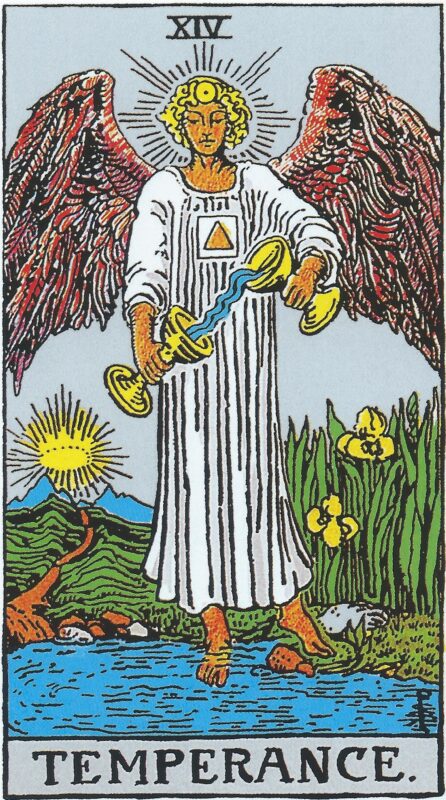
Temperance comes right before the Devil in the Tarot, and with the Tower following after. I find this lineup very interesting, actually. Not sure why yet, but it will probably become clearer as I write. When studied in depth, the theme of Temperance is about changing the world and having fun doing it. We often become overly serious, especially when working through some really hard stuff, but this card calls more for moderation, fluidity perhaps, and even adaptability. As discussed previously, the cards are a reflection of our own lives, so when we say changing the world, we are obviously referring to our own personal world.
One of the main themes here is finding the right measure while aiming for the highest goal in life. We have to touch earth before aiming for the sky, because how would we know the meaning of the sky without its opposite, the earth? Basically, it is an invitation to grasp the contradiction of life with both hands. This is the work of the alchemist, male or female. It is regarded as the aim of the Great Work, or the mysterium coniunctionis (the secret of union), or opus magnum (the marriage between heaven and earth).
The Great Work is, however, a lifelong task, and this is portrayed by the long road in the image. The long road warns us against long-windedness, false ideals, and complicated procedures. Before we can awaken the angel within, our greatest potential or the supernatural, we must work a whole lifespan, with trial and error, until the right measure is found.
When I read tarot once upon a time, lol, I often likened Temperance to our ability to reconcile opposites. A simple example is when we ask, how could someone be such a cold-hearted criminal? I will never understand it. While the alchemist undergoes the whole experience, they come out on the other side transformed, illuminated, and having integrated a part of the self with a clear-as-day understanding. This kind of work is energetic, psychological, spiritual, mental, emotional, and physical.
What I am saying here is that before we call ourselves an angel, we have to work with the soil. We have to work with dirt, get our hands dirty, clear out the weeds that have grown from an untended past, and then plant the ideas that can blossom into a new personal world. Those who refuse to get their hands dirty, which you will find many of in the spiritual community, are obviously spiritually bypassing. These are the parasites in the spiritual community. They feed on the fruits of others.
The spiritual experience of Temperance
We need to be patient. We are still in purgatory, a process of refinement, as long as the right measure has not been found. In purgatory, we are still dealing with perfectionism, unrealistic idealism, or a flight into delusion. In its positive meaning, we are purging, combining the infinite with the necessary. The breastplate on the angel contains a triangle and a square, with the triangle standing for femininity and spirituality, and the square for masculinity and matter. Above the amulet are the four Hebrew letters J H V H.
Finding the right measure also means achieving the right state of tension and balance of opposites. We have to be willing to grasp the contradictions in life and find a relationship between them where they begin to flow. We have to grasp the true contradictions of our lives and see things as they are, because precisely there we can find the personal will to achieve our aim. If we want honesty, for example, we cannot keep punishing people when they tell the truth.
Contradictions can also be resolved and reconciled by creating a potential difference between them so that things can flow. Temperance reminds us that our destiny is best found in the lifestyle that harmonizes most with our personal self. We are called to be more mindful against stagnancy or indifference with respect to our life’s goals and adopt a more neutral attitude at this time. When things flow, unity and illumination in the third eye are possible.