The Bhagavad Gita | Classical Yoga
Before diving into the world of action, let’s explore some classical yoga traditions and their understanding of it. In the Bhagavad Gita, one of the foundational texts of yoga philosophy, a book that I highly recommend not just to yogis but to any reader, the warrior Arjuna is taught by Krishna to complete his duties without attachment to success or failure. This teaching, known as karma yoga, emphasizes that while we control our actions, we cannot control their results.
Arjuna, the warrior prince and one of the key figures of the Mahabharata, becomes the student of Krishna in the Bhagavad Gita. Caught in a civil war within the same royal family, including his cousins, uncles, teachers, and other relatives, faced with having to kill the people he loves and respects, and consumed by grief, he questions whether the battle is even worth fighting at all. He wants to withdraw from life because action seems morally impossible. Krishna, on the other hand, teaches him that the answer lies not in escaping action, but in transforming one’s relationship with it. Freedom comes from acting ethically and skilfully while surrendering attachment to outcomes.
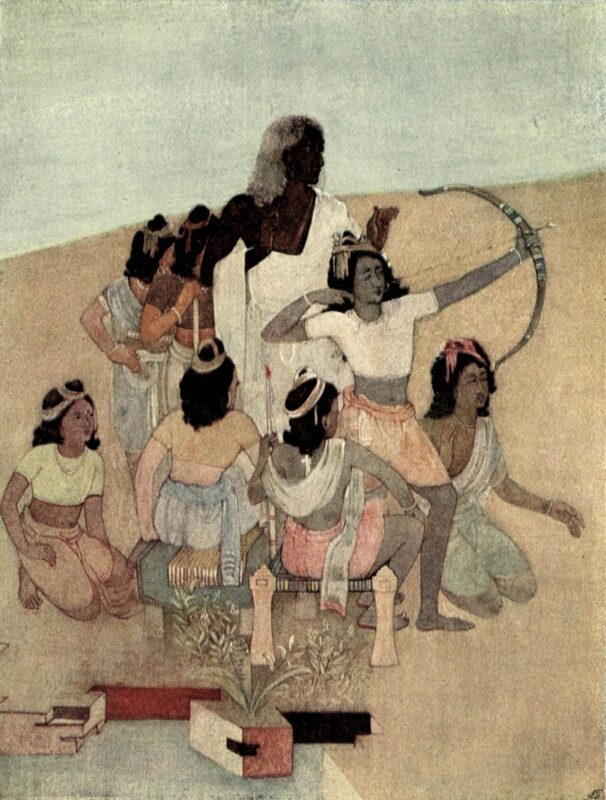
It’s interesting to go back to this book after having lived a little. The last time I studied it was during my first yoga teacher training in 2013. Good thing I like to be organized sometimes and highlighted what I thought was most interesting throughout the chapters. In Chapter 3, Krishna knows that Arjuna is not the type to disengage himself and go off in search of the mystical vision because an active life is essential to him. The danger, of course, of a life of active engagement in the world is that Arjuna will get caught up in his actions and begin to act out of selfish motives. If this were to happen, he would be doomed to spiritual failure. Having a good deal of self-knowledge, Arjuna senses this danger and asks Krishna a fundamental question: What power binds us to our selfish ways? Even if we wish to act rightly, so often we do the wrong thing. What power moves us?
Krishna replies that anger and selfish desire are our greatest enemies. They are the destructive powers that can compel us to wander away from our purpose, to end up in self-delusion and despair. In Sankhya, one of the six traditional schools of Indian philosophy, selfish desire and anger arise from rajas, one of three gunas. So Krishna warns Arjuna that his true nature, the Atman, is above entanglement in the gunas. Sattva (goodness, light, purity), Rajas (passion, activity, energy), and Tamas (darkness, ignorance, inertia) are the three gunas in Sankhya philosophy. It is taught that spiritual evolution progresses from Tamas to Rajas to Sattva, and final liberation takes the soul beyond the three gunas altogether.
Even if we live intentionally and spiritually, we are still bound by Rajas, whether we like to admit it or not. Of course, we have to make a living and find a way to serve at the same time. But if our desire to serve or achieve a particular milestone outweighs our purpose, we will inevitably suffer. For example, imagine you wrote a book tomorrow about how to make the best chocolate cake in the world, hoping to share your gift, your talent, your story, and what carried you through the most difficult times in your life. If, however, your drive for fame and success outweighs your purpose to share that gift to help others, you remain attached. Your action may appear meaningful on the surface, even to yourself, but your attachment to the outcome keeps you suffering and bound to the world of action, therefore karma. “You have a right to action, but never to its fruits.” (2.47) The most famous verse on action in the Bhagavad Gita highlights that freedom comes from acting wholeheartedly without becoming psychologically dependent on success or failure. Krishna explains that no one can remain without acting even for a moment. The question is not whether we act, but whether action binds us or liberates us.
The Yoga Sutras
In classical Yoga, as presented in the Yoga Sutras (another fundamental text in the practice and study of yoga), Patañjali shares that inner liberation is achieved by stilling the fluctuations of the mind so that our true nature, the Purusha or Self, can be directly realized.
Some verses worth noting from the Yoga Sutras of Patanjali:
- Yoga is the cessation of the fluctuations of the mind (1.2). This explains why action itself isn’t the problem; the restless mind is.
- The five kleshas. (Book 2) Ignorance, ego, attachment, aversion, and fear of death are what make action compulsive rather than conscious.
- Non-attachment (Vairagya) (1.12–1.16). Practice and non-attachment work together. We continue acting, but gradually loosen our dependence on outcomes.
- In Kriya yoga, as described in the Yoga Sutras, discipline, self-study, and surrender to the Divine are practices that purify action itself.
So, together, these traditions teach that action itself is not necessarily the obstacle, but suffering arises when we identify with the results of action, the ego (the image we project onto the world), and the constant pursuit of pleasure or avoidance of pain. When we act with awareness and without clinging, it becomes a means of spiritual freedom instead of further bondage.
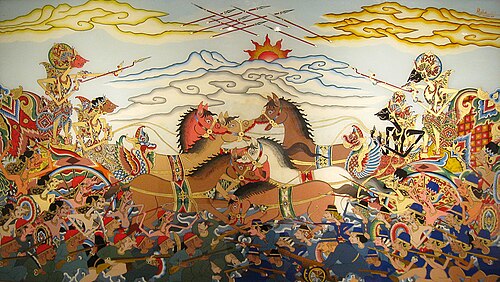
The Eternal Godhead & The World of Action
I randomly opened the Bhagavad Gita again and landed on chapter 8. I like to do that sometimes with old books.
Arjuna:
“O Krishna, what is Brahman, and what is the nature of action? What is adhyatma, the adhibuta, the adhidhaiva? What is the adhiyajna, the supreme sacrifice, and how is it to be offered? How are the self-controlled united with you at the time of death?”
Krishna:
“My highest nature, the imperishable Brahman, gives every creature its existence and lives in every creature as the adhyatma. My action is creation and the bringing forth of creatures. The adhibhuta is the perishable body; the adhidaiva is Purusha, eternal spirit. The adhiyajna, the supreme sacrifice, is made to me as the Lord within you.
Those who remember me at the time of death will come to me. Do not doubt this. Whatever occupies the mind at the time of death determines the destination of the dying; always they will tend toward that state of being. Therefore, remember me at all times and fight on. With your heart and mind, intent on me, you will surely come to me. When you make your mind one-pointed through regular practice of meditation, you will find the supreme glory of the Lord.
The Lord is the supreme poet, the first cause, the sovereign ruler, subtler than the tiniest particle, the support of all, inconceivable, bright as the Sun, beyond darkness. Remembering him in this way at the time of death, through devotion and the power of meditation, with your mind completely stilled and your concentration fixed in the center of spiritual awareness between the eyebrows, you will realize the supreme Lord.”
The chapter goes on to explain the eternal state, the senses, energy, cosmic laws, the six months of the northern path of the sun and the southern path of the sun, etc. I just really liked the start of this chapter and thought it was worth mentioning here. What I’ve gotten from revisiting some of these books is that the world of action is not necessarily evil, something we’re all aware of, but what can make it so are the three fundamental qualities or tendencies of nature. These are the qualities that influence matter, the mind, emotions, and behavior. The true testing ground is not so because of some omnipotent being above the clouds waiting to punish us, but rather because we ourselves are the punishers. We punish ourselves when we lack self-study and become bound to our own actions, and most importantly, to what drives our actions, or in other words, the relationship we have with our own world of action.