Alchemy and Its Earliest Origins
Spirituality is more than just an abstract thought that developed thousands of years ago. It is rooted in all forms of art, including science, astrology, astronomy, physics, medicine, and so on. As I’ve mentioned in other posts on alchemy, which you can find in my search bar, spirituality is simultaneously developed with the development of mankind.
Alchemy drew from different disciplines that shaped our early understanding of the universe and mankind, specifically from metallurgy, where they experimented with heating, melting, and purifying various metals. It also drew from medicine, where minerals, plants, and compounds were studied for healing purposes. Cosmology and astronomy were key to the study of alchemists, as they helped shape our understanding of patterns, mathematics, geometry, and cycles of time, which gave us a clearer structure of the order of the universe. In philosophy, alchemists explored the nature of matter and inner transformation. All these disciplines influenced scholars and practitioners for centuries through texts that were originally written in Greek and translated at different times into Arabic and Latin. Spiritual symbolism often emerged as a way to describe processes of change and refinement within the material world and the human spirit.
When we look at the timeline of the alchemists, they emerged during the Hellenistic period in Egypt, in Alexandria, to be precise. This was after the Egyptians had already experienced their golden age of enlightenment, spiritually speaking, and eventually, following its fall, a new era of development for humankind had to begin. Something I discovered recently, which I found quite interesting, is the Egyptian language and how it was eventually replaced after the Arabic conquest and the standardization of the language in the region. The ancient Egyptian language evolved through different stages over thousands of years. Early Egyptians wrote their language using hieroglyphs, as we all know, and later, more simplified scripts, such as demotic, were used for everyday writing.
Egyptian Language, Scholars, and Artisans
As time passed, the spoken language continued to develop, eventually becoming what we know as Coptic, the final stage of the ancient Egyptian language. My father, God rest his soul, had a degree in the study of ethnolinguistics, and discussions about different languages and how they developed in parallel with their people and culture were a familiar theme at our dinner table. Anyhow, Coptic was spoken but written largely using the Greek alphabet, with a few additional characters derived from early Egyptian to represent sounds that Greek did not have. So the language did not become Greek. It was simply a change in writing practice while the original Egyptian language continued to evolve.
Now, alchemy did not appear out of the blue. It formed in Alexandria between roughly the 1st century BCE and the 3rd century CE because a combination of various traditions came together in one place. This is important to remember because often we think of different fields as separate from one another, while the truth is that they are all in sync and together they evolve as humankind evolves.
As many of you know, Alexandria was a major intellectual center of the Hellenistic world. We are all somewhat aware, I hope, of the great library of Alexandria, which was gradually destroyed sometime between the 1st and 4th centuries CE because of political and religious conflicts in the late Roman period. Greek scholars, Egyptian philosophers, physicians, craftsmen, and metalworkers were all working in the same environment. What became “alchemy” as we know it developed out of the practical work they were already doing there.
Dyeing was also one of the important crafts that contributed to early chemical experimentation. Artisans who worked with textile dyes had to understand how substances reacted with heat, minerals, plant extracts, and salts to fix color to fabric. In Alexandria, artisans not only worked with textile dyes, but they also experimented with pigments for painting and decoration, cosmetics and perfumes, glassmaking, and metal purification.
The Metals and the Cosmos
Before I move on to my favorite part of this elaborate post, I think it’s worth mentioning my dream this morning at 4:30 am. I was too scared to fall asleep afterward, but somehow I’m still here, sleep-deprived, with a headache, bad allergies, and writing this post. Last night I had a dream where I was in my house and an unfamiliar Asian woman was sitting on my bed. She had a strange hat on and kept glancing toward the kitchen area as if she could see someone there, and it felt obvious that someone was present even though I couldn’t see them myself. When I asked if someone was there and who they were, she described the being telepathically as humanoid but bird-like. Almost at a loss for words, she said, “pigeon-like.” Instantly, when she said that, my mind associated it with the phoenix.
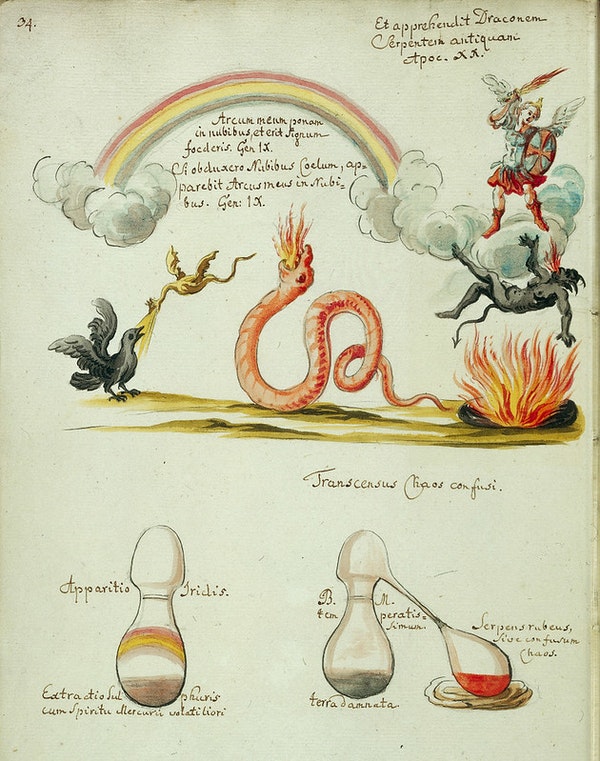
Then I decided to fly toward her, because flying is my favorite thing to do in dreams, and scare her with spooky ghost sounds, because I like to annoy people like that. Now, as I looked again at the fist alchemical image I chose for this post, I noticed it contains both a bird and a phoenix above it. I can’t make this up, but call it a nice synchronicity between the dream, its message, alchemy, and whoever reads this. It’s not the first time I’ve noticed such synchronicities with alchemical imagery and the mental and spiritual worlds we move through. I am truly mind-blown.
The Basic Metals | Alchemy
The seven basic metals became essential to the work of alchemists because they were some of the most visible materials that could be transformed through heat, melting, purification, and alloying. Now, there was no such thing or title as alchemist in the development of alchemy itself. Even an apothecary was an alchemist, experimenting with medicinal formulas while mixing herbs and extracts. Ancient craftsmen like blacksmiths, glassmakers, dyemakers, including herbalists, and others had already learned how metals changed when exposed to fire, minerals, and different mixtures. These transformations captivated early alchemists. To them, metals were not static substances but materials that could evolve, refine, and move toward a more perfect state.
Each metal was associated with a planet because of its character and qualities associated with it: gold with the Sun, silver with the Moon, iron with Mars, copper with Venus, tin with Jupiter, lead with Saturn, and mercury with Mercury. Sulfur, salt, and antimony were also studied because they revealed different properties of matter. Sulfur was very important and transformed through fire, salt was associated with stability and preservation, and antimony or stibnite found in rocks was used for purification processes that helped separate and refine other metals. Together, they helped alchemists explore how substances could break down, recombine, and transform, which was the heart of their experiments.
What I find so fascinating is that they didn’t have the tools or technology we have now, yet with simple pots, distillation processes, and simple separation methods, they were able to extract pure sulfur and antimony to create stronger metals. Iron, for example, is often found in ores that contain sulfur compounds, which make the metal brittle and weak. When the ore is heated in furnaces, sulfur burns off as gas, leaving behind purer iron. Once the sulfur and other impurities are removed, the metal becomes stronger and more workable. This purification process was essential for producing reliable iron tools and weapons.
Sulfur, Purification, Health | Alchemy
Also, purifying sulfur, separating it from rock and mineral ores with such simple methods as slow heating, melting, draining, or distillation, allowed them to use it in many ways. It was used in medicine, especially in powders and ointments, to treat skin diseases and infections because of its disinfecting properties. Purified sulfur was also an important ingredient in early pigments and dyes due to its bright yellow color. Later, it became a key component in gunpowder when mixed with charcoal and saltpeter, and it was also used in various chemical reactions with metals and minerals because it burns easily and reacts strongly with other substances.
So sulfur’s role was mostly in revealing and separating impurities during heating, or what alchemists called roasting. These processes helped shape metal purification and the development of stronger alloys such as copper and tin mixtures. But they also influenced other developments because the same principles of heating, extraction, and distillation eventually led to substances like ethanol, which became important for medicines, disinfecting, and the early foundations of pharmacy and public health. We would not have the world we have today if it were not for the alchemists. Yes, the philosophy was there, and most people did not understand it at the time, and many were even persecuted, but they understood the unity of the cosmos, the relationship between metals and planets, rocks, heat, and transformation, and how gold was attainable through the seven stages of alchemical work in the laboratory.
The same goes for every era and generation. We guide future generations through our own experimentations and discoveries, whether in technology, like AI, medicine, public health, or even in how spirituality is understood and continues to develop. Many will not understand and will do the same as they did with the alchemists. They won’t hold back from calling you a fool, ridiculing you, or worse. Even today, I almost gave up on writing this post. I had the overall idea, and the seed was planted weeks ago, as it usually happens with my posts. But I didn’t know where to begin. There was so much to say and so many ideas to put together that I almost gave up. Now that it’s done, I’m glad I didn’t stop. My head feels like it’s going to explode, but I know I’ll rest a little better having given it my best.
For the alchemists, the work in the laboratory was parallel to the development of the soul and the development of intellectual faculties, which also guided them in how to experiment better and make new discoveries. We often underestimate ourselves and think we don’t matter. Many times, I find myself cringing at the thought of calling myself a spiritualist or a spiritual teacher because of so many people’s ungrounded claims, distortions, or exploitations of teachings for selfish reasons. But lately, if I have to be honest, the crazier the world gets, the more at peace I feel with calling myself a spiritualist. At least I know my intention and what I can offer through my own growth.